
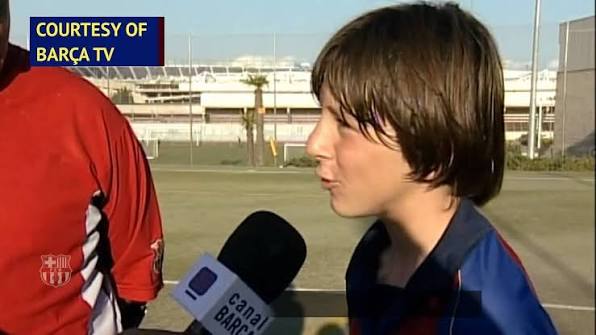
Lionel Messi was rejected by Argentina's two biggest boyhood clubs because of his height. Harry Kane was released by Arsenal at eight years old for being "a bit chubby." Neither rejection had anything to do with what either player could actually do with a ball. Both had everything to do with what their bodies looked like at that specific age.
These aren't just two good stories academies like to tell after the fact. They're the visible tip of a pattern that's been measured across tens of thousands of young athletes and dozens of sports: kids get evaluated, again and again, on physical development instead of ability - and the mistake is consistent enough that researchers can actually put a number on it.
Two players, one mistake
Messi was diagnosed with a growth hormone disorder as a child. At an age when he shouldn't have been, he measured 4'2". River Plate and Newell's Old Boys, the two clubs with the first look at him, both passed - not because scouts doubted his feet, but because neither club wanted to pay for the treatment he needed. Barcelona signed him at 13 instead, on a deal reportedly written on a napkin, with the club agreeing to cover his medical bills as part of the contract.
"He was a bit chubby, he wasn't very athletic, but we made a mistake."
Liam Brady, Arsenal's academy director at the time, on releasing an eight-year-old Harry KaneKane went on to become the second-highest goalscorer in Premier League history. Both players were cut around the same age range - eight to thirteen - on the same basis. Not talent. Current physical presentation.
It's not an anecdote. It's a measurable bias
A 2021 study published in PLoS ONE tracked 38,381 young athletes, ages 9 to 14, across 37 competitive sports in Bizkaia, a province in Spain's Basque Country - one of the largest studies of its kind ever conducted. The researchers compared birth dates against selection into top competitive tiers, and found the same story playing out at scale.
Neither number reflects skill. It reflects who happened to have up to eleven more months to physically develop before a coach made a selection decision.
The effect nearly disappears in judo, taekwondo, swimming, and athletics - sports that are individually measured or weight-categorized. It shows up hardest exactly where a coach is looking at a group of ten-year-olds and deciding, by eye, who "looks" like the better athlete.
Does getting cut early predict making it? The evidence is mixed
The same Bizkaia researchers describe something they call the "relative age effect reversal": evidence that at the professional level the pattern can flip, with relatively younger athletes overrepresented among the adults who make it as pros, and outperforming once they get there. A 2023 study of world-class athletics found a comparable reversal at the junior-to-senior transition.
This isn't settled science across every sport. A widely cited 2010 study of NHL, WHL, OHL, and QMJHL rosters found the opposite in ice hockey - the standard relative age advantage persisted all the way to the pros, with no reversal detected. Other researchers have since pushed back on that finding in turn. What's well established is the initial selection bias. What happens to a cut player afterward looks like it depends on the sport.
What some programs are already doing about it
In 2017, Reading, Southampton, Stoke City, and Norwich City academies ran a tournament regrouping 11-to-14-year-old players by biological maturity instead of chronological age, designed with Dr. Sean Cumming at the University of Bath. Later-developing players came out more confident and better on the ball. Early-developing players had to actually rely on technique instead of coasting on size.
The Dutch football federation, KNVB, ran its own "call to action" in 2021, collecting 143 proposals from coaches and researchers on fixing relative age bias nationally, and is now testing which ones actually work rather than assuming a single fix applies everywhere.
On the consumer side, apps like GoTall are trying to solve a narrower piece of it - predicting a child's likely adult height instead of judging talent off current size. It's early and unproven at the elite level, but the instinct, projecting what a body will become instead of grading what it looks like today, is the right one.
What academies should actually measure instead
The uncomfortable part isn't that relative age bias exists. It's that fixing it doesn't require better eyes or more tryouts. It requires measuring something that doesn't fluctuate with a growth spurt: effort, coachability, decision-making under pressure, how a player responds after a bad rep.
That's the actual argument for tracking development longitudinally, season over season, instead of grading kids against each other at a single tryout - which is, not coincidentally, the problem Future Stars was built to help academies solve.
Messi and Kane are the two examples everyone already knows the ending to. The real question for any academy is how many other endings never got written, because the player in question got cut at ten and nobody ever found out what came next.
Squad Intelligence - Track the birth-month distribution of your own roster. If your top team skews heavily toward the first half of the selection year, that's a signal worth checking, not a coincidence.
Squad Intelligence - Don't grade talent at a single tryout. The relative age effect shows up hardest exactly when selection is a one-time, subjective, by-eye judgment call.
Mental Performance - Measure what doesn't change with a growth spurt. Effort, coachability, and decision-making under pressure are comparable whether a kid is the biggest in the room or the smallest.
Squad Intelligence - Consider bio-banding for training, even informally. Regrouping players by physical maturity instead of birth year, even occasionally, forces technique to matter more than size.
Mental Performance - Don't assume every cut kid is a future star, or that the survivors are automatically the best available. The research is honest that what happens after a cut varies by sport - track your own outcomes rather than assuming either story.
Sources
Gil et al., "The relative age effect in young athletes," PLoS ONE, 2021 · Nolan & Howell, "Hockey success and birth date," International Review for the Sociology of Sport, 2010 · University of Bath, bio-banding trial, 2017 · KNVB relative age solutions project, Frontiers, 2025 · Sky Sports, Liam Brady on Harry Kane, 2018 · Bleacher Report, Messi and HGH · GoTall