
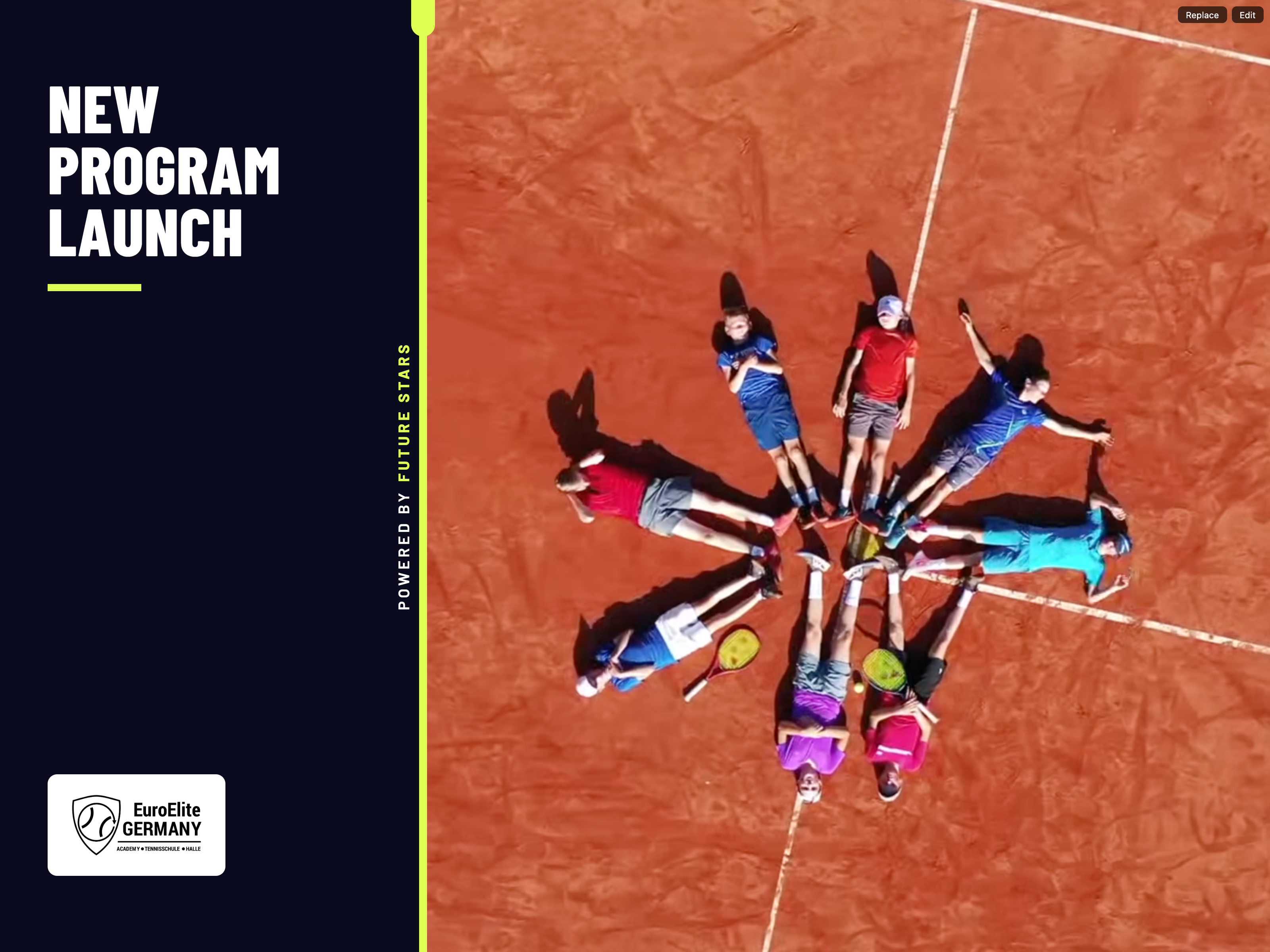
EuroElite Germany Academy just went live on Future Stars.
EuroElite doesn’t treat the mental game as an add-on. Their own description of what they build is “technical skills, tactical awareness, mental toughness, and character development” - one list, not four priorities ranked in order. Their founder, Mike Andreasson, studied sports psychology in Sweden, and his top players have been doing daily reflections for years - writing about how they felt after each session.
Future Stars is built as a three-sided product: players build the reflection habit, coaches get a real signal across the whole squad instead of relying on memory, and parents get visibility without ever needing to ask. Same weekly check-in, three different jobs done.
The idea was never the problem - the friction was. Daily reflection is easy to ask of a disciplined teenager, much harder to ask of an 11-year-old staring at a blank notebook. Future Stars didn’t start that habit at EuroElite. It made it effortless enough that every player keeps up with it, not just the self-motivated ones.
There are two check-ins, and they’re built for two different jobs.
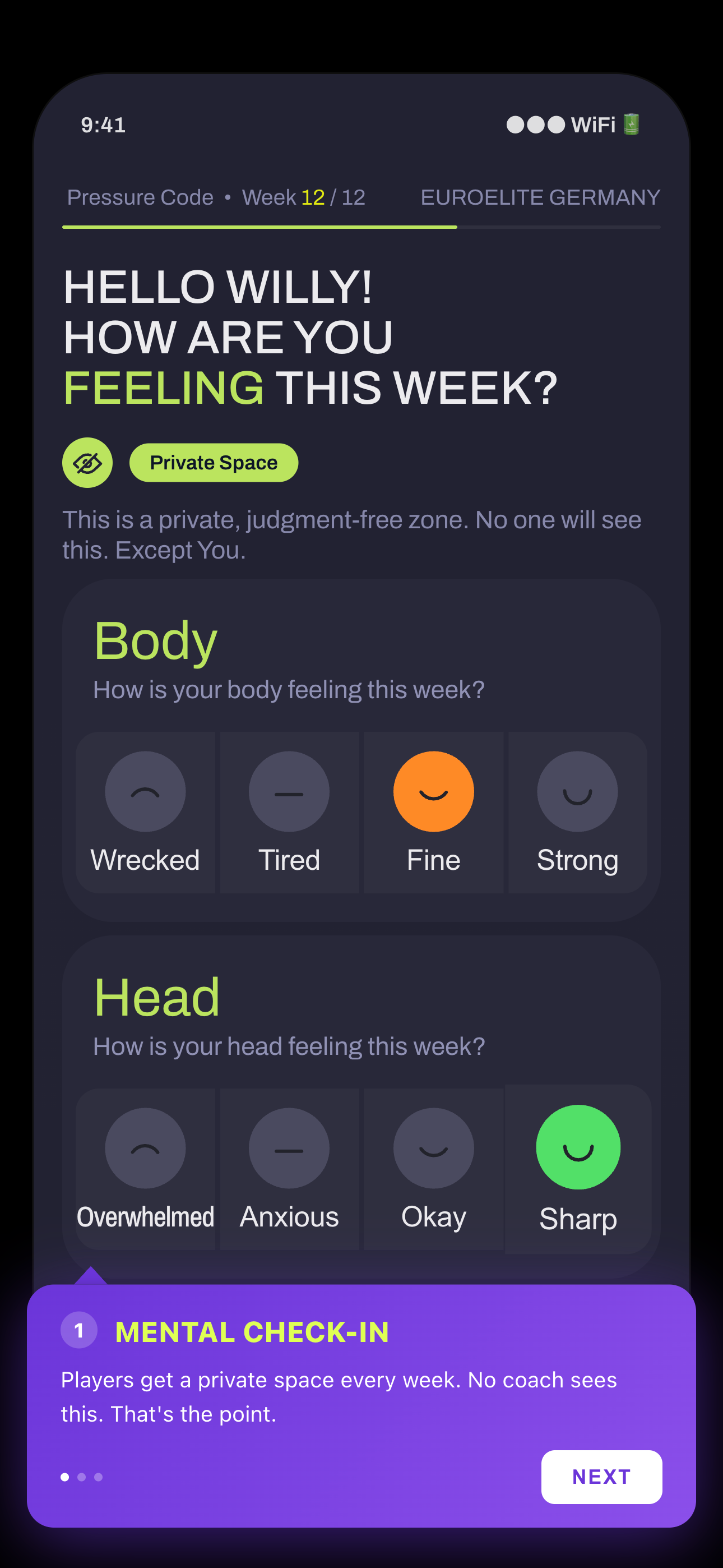
One is private. Body, head, pressure readiness - answered honestly because no coach ever sees it. Not a form, not evidence, just the one place in a junior’s week where nobody is grading the answer. No prompts to overthink, no blank page. Tap the face that matches how you feel.
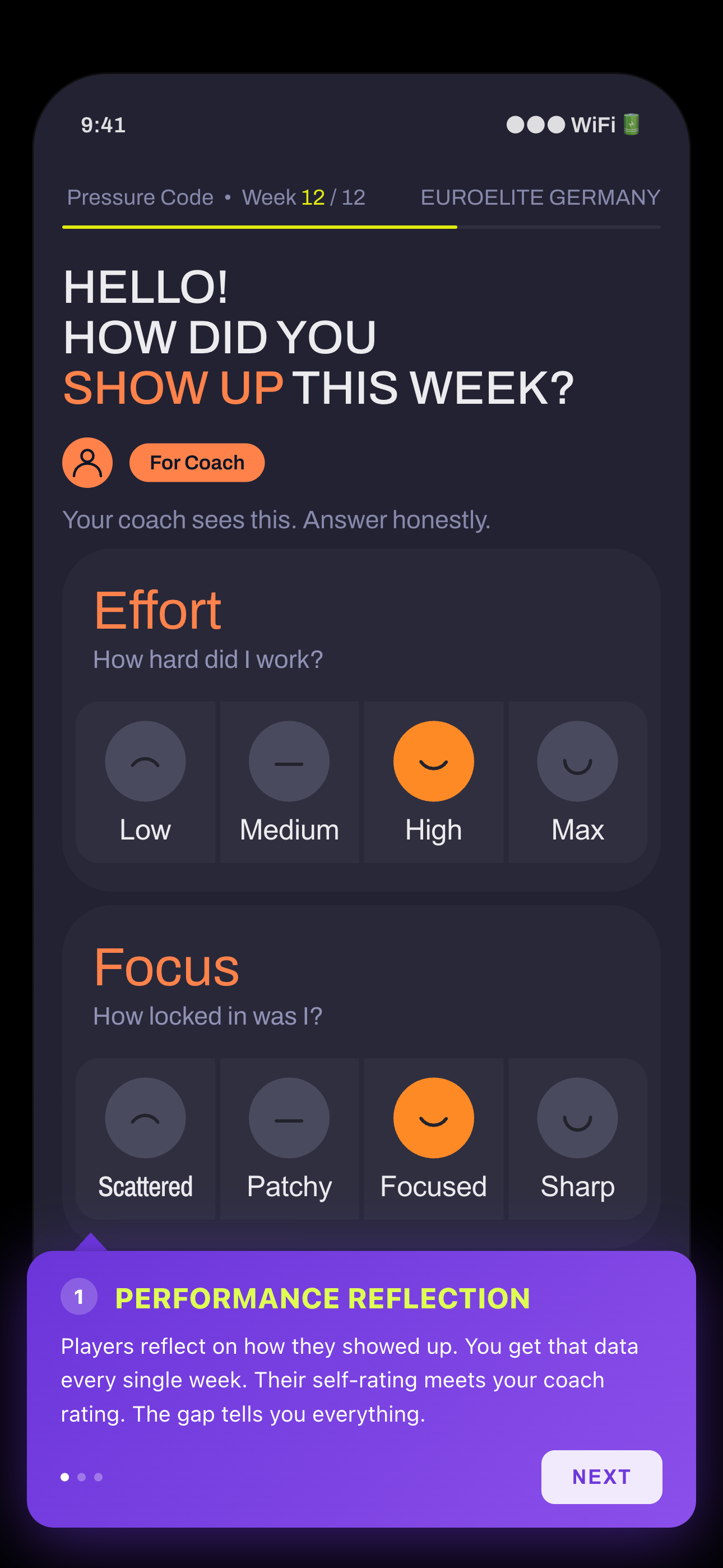
The other goes straight to the coach - effort, focus, mindset - built to be shared, on purpose, so a coach isn’t left guessing what a player actually felt during a session they didn’t fully see.
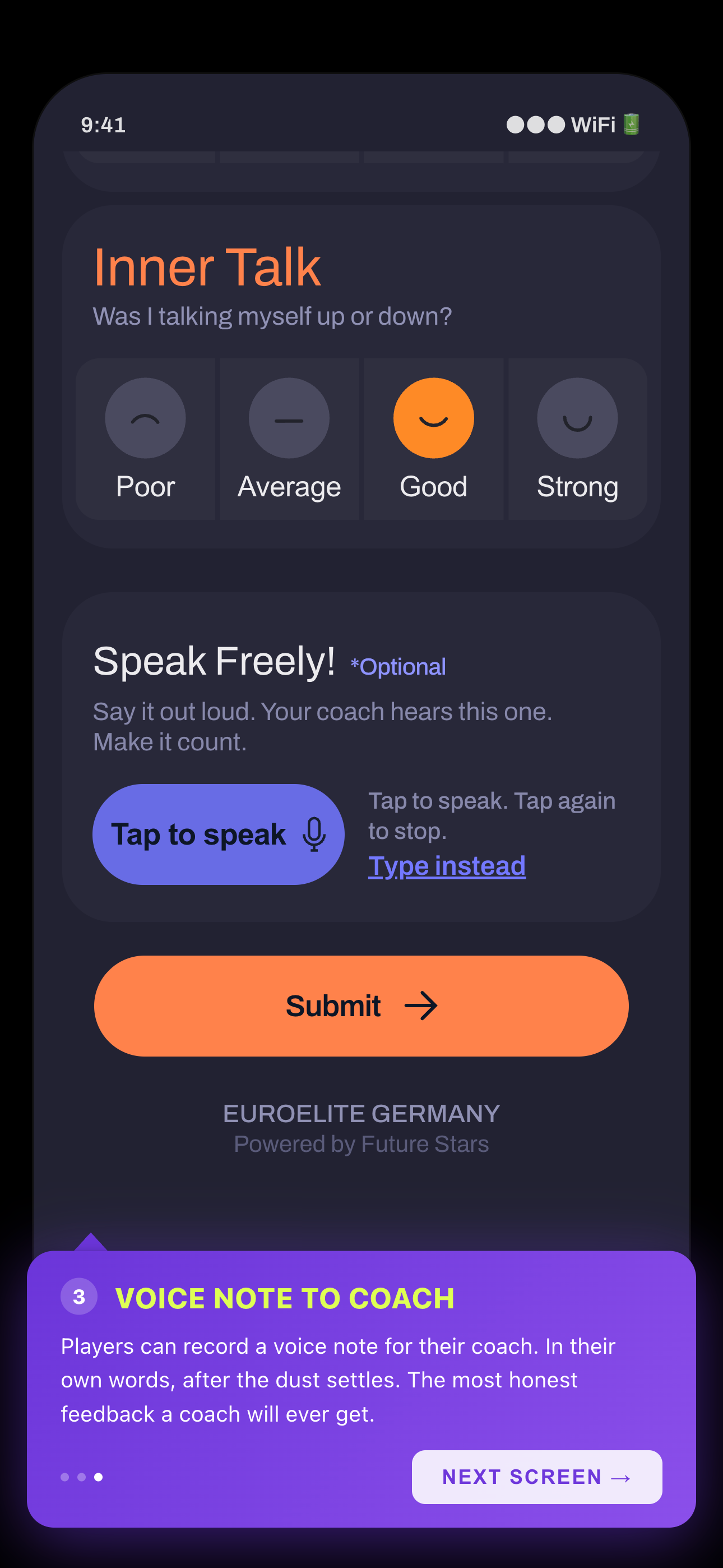
And when a player wants to say more than a tap can capture, there’s no keyboard required there either. Tap, talk, done. That single change - typing to talking - is what took reflection from “something the disciplined top players do” to something every player at EuroElite Germany Academy can actually keep up with.
“What surprised me most is how easy this is for everyone - my coaches check in during a 5-minute break between sessions, and the players just talk instead of writing,” said Mike Andreasson, Owner of EuroElite Germany Academy.
What the coach actually gets
A coach opens Monday morning and already knows what kind of week it should be. Not a feeling. Not a guess based on how the last session went. An actual answer.
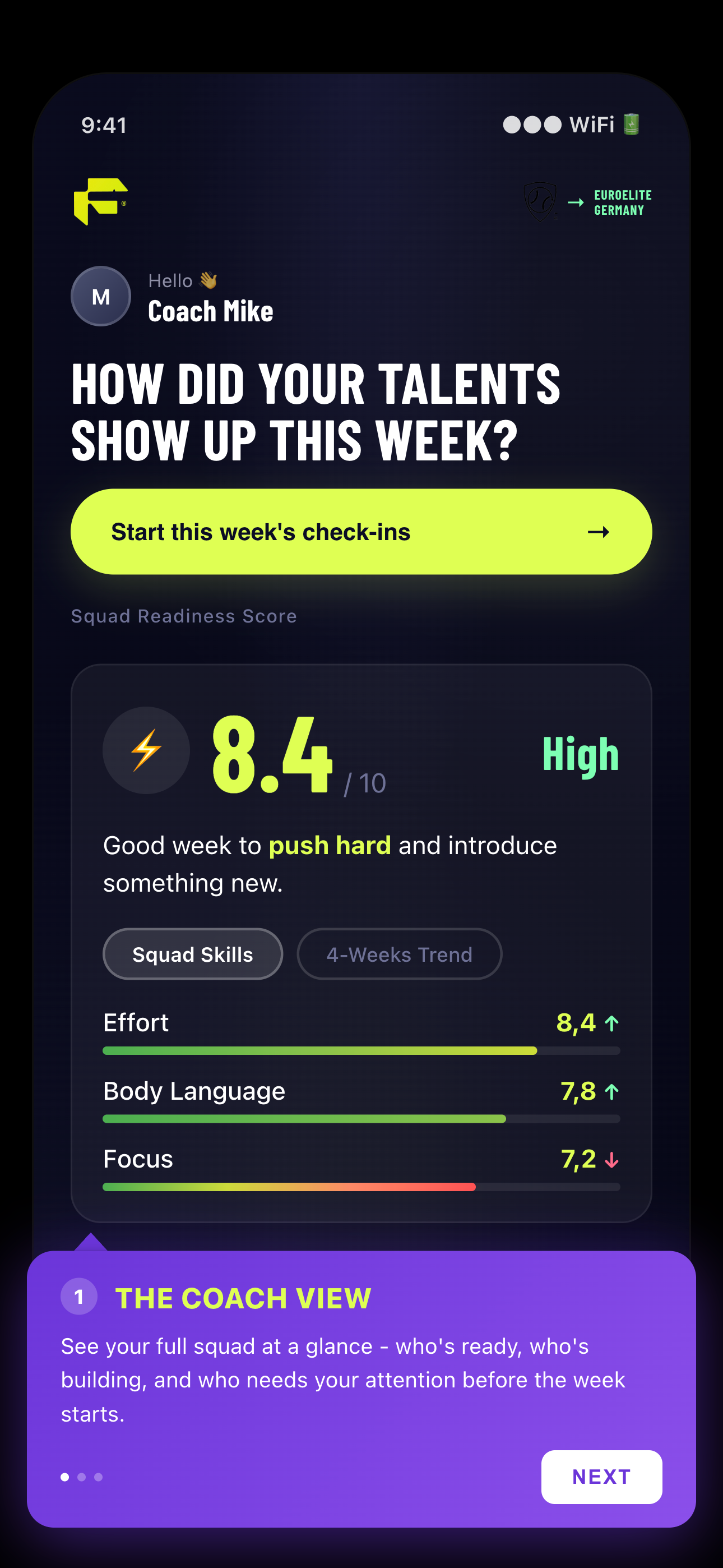
This week it’s 8.4, High - push hard, introduce something new. That’s the whole squad, told to the coach before a single ball is hit. And when something’s off, it doesn’t hide in the average - effort and body language are both climbing, but focus is slipping, and that’s a different conversation than “the team seems tired.” A coach walks in already knowing which one it is.
The curriculum underneath it
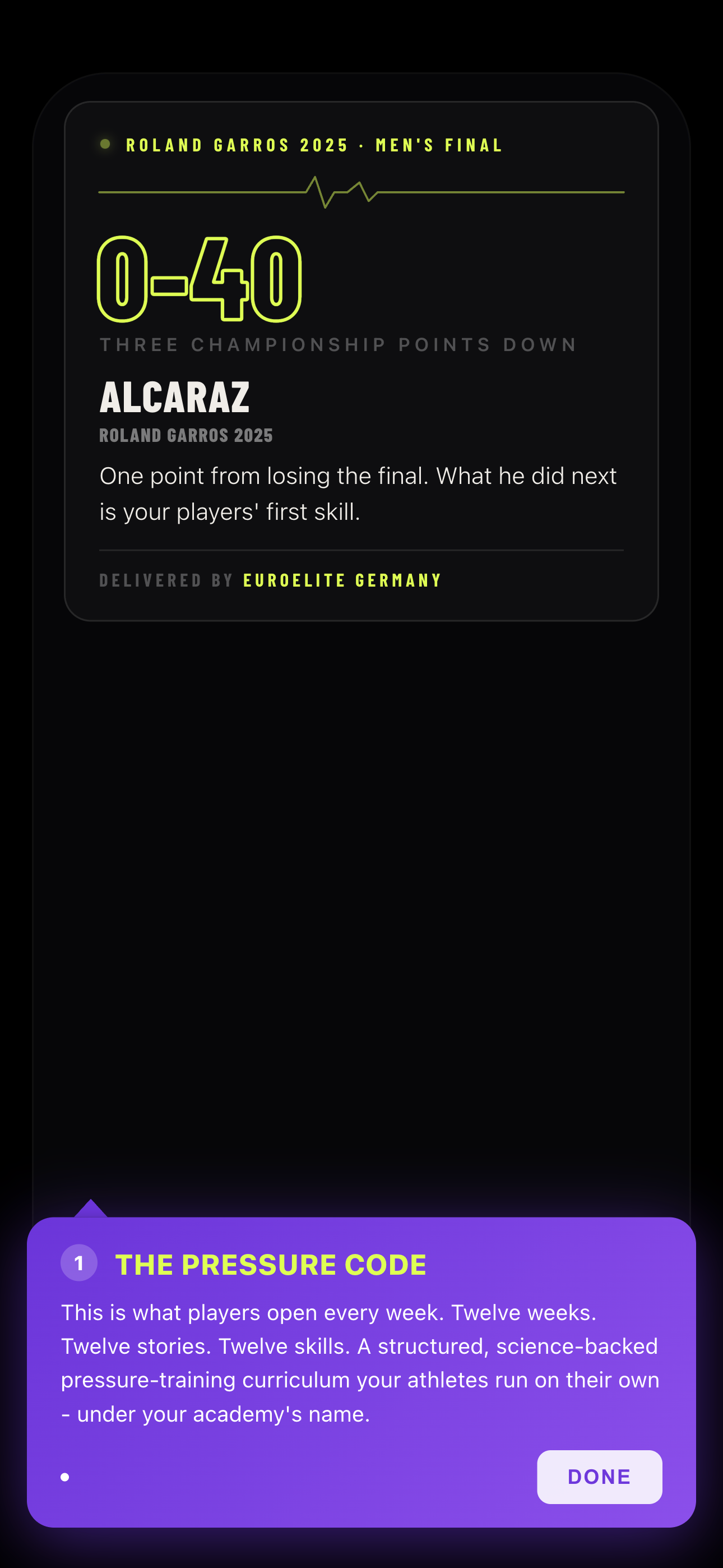
The stories and skills are the hook. The reflection is what happens underneath it.
Twelve weeks. Twelve pro stories. Twelve pressure skills - Alcaraz, Djokovic, Sinner, Biles. Players don’t sign up to journal, they sign up to learn how the greats handled the moment they’re about to face. The skill is the draw, and the reflection rides along quietly every week, tied to that week’s story.
It’s not the same twelve weeks for everyone, either. A 2-minute assessment before week one sorts players into four pressure types - Perfectionist, Captain, Gladiator, Overcomer - and the language of every weekly reflection speaks to that profile. Same Djokovic story, same skill, but the prompt for a quiet player who overthinks every mistake asks something different than the prompt for the vocal leader who rallies the team. Same twelve pros, delivered differently, because their pressure doesn’t look the same.
Parents stay where Mike wants them - informed
EuroElite runs one of the more unusual parent cultures in junior tennis: high-pressure sport, zero pressure from parents. Mike and his team sit down with every family before a kid joins. The deal is simple - parents are experts in their own field, EuroElite is expert in developing juniors, and communication runs through the player, not around them. It’s why families stay.
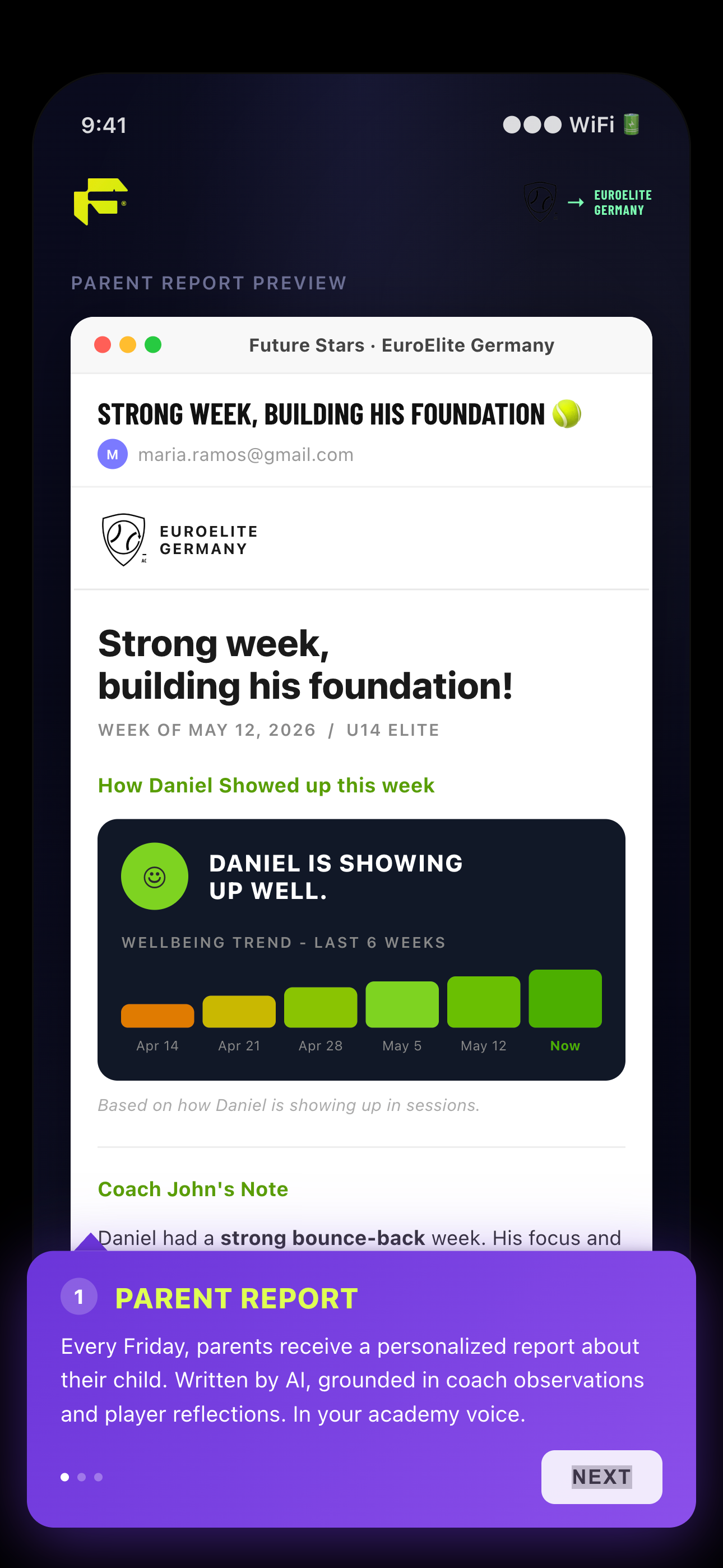
Every Friday, parents get a report written in EuroElite’s voice - not typed by a coach, but generated by AI from what the coach actually observed and what the player actually said that week. It’s not a workaround for the parent boundary - it’s what makes the boundary possible to hold. No coach has to sit down and write forty parent updates by hand. The data already exists; it just gets turned into something a parent can read.
“EuroElite is exactly the kind of academy we built this for. They already treated the mental game as seriously as the physical game, long before we showed up. We didn’t have to sell them on the idea - we just made it easier for them to do what they already believed in,” said Andras Nemes, Founder and CEO of Future Stars.
Mental toughness was always supposed to get the same rigor as technical training at EuroElite. Now it does.
Where this is headed
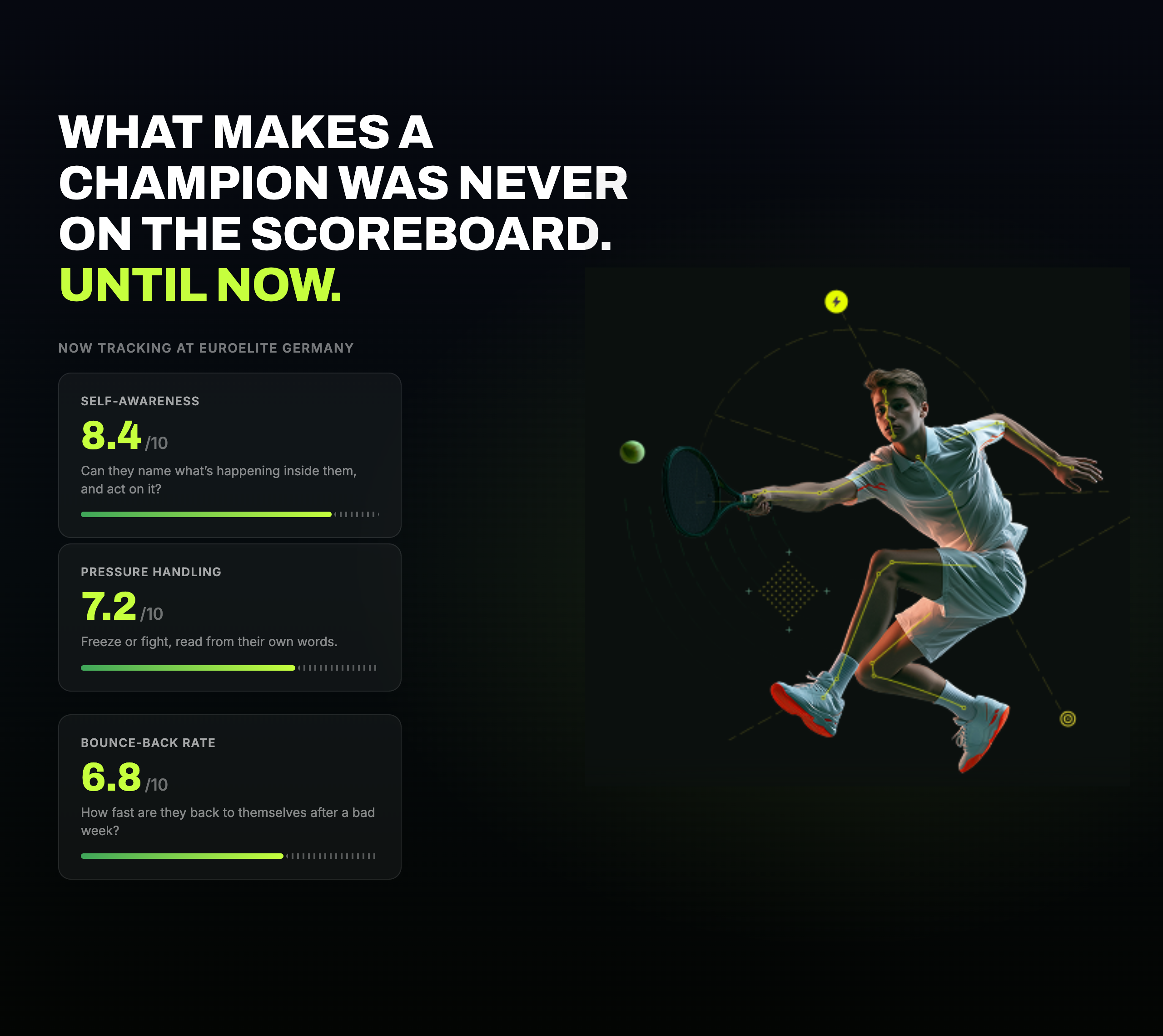
Right now, a EuroElite player’s numbers mean something next to their own history: this week against last week, this season against last. That’s already more than existed before. It gets more useful for EuroElite specifically once there’s something to measure against beyond their own squad.
A real reference point, not a guess
The plan is anonymous benchmarking across every academy running Future Stars, and for EuroElite, that means an actual answer to a question Mike currently has to guess at: are our 14-and-unders ahead or behind on pressure handling compared to academies at a similar level.
Proof for the recruiting packet, not just a coach’s word
A EuroElite player’s forehand is on video, and any scout can judge it cold. His Bounce-Back Rate isn’t, and until now the only proof he handles pressure well was Mike saying so in a letter. Once there’s enough data across academies, a quietly elite player on Pressure Handling has a number next to his name - something just as concrete as the video a scout already trusts for the forehand.
A coach who knows what kind of week it is before he calls it
A player’s effort and body language are on the whiteboard every week. His focus isn’t, not really, not in a way Mike can act on before the first ball is hit. Now it’s effort and body language climbing while focus quietly slips - a different conversation, and one Mike’s having on Monday morning instead of guessing his way into it by Wednesday.
Reps get sharper the longer a player’s been at EuroElite
Every player gets the same Alcaraz story and a skill in week one. What changes is how it’s used. Twenty minutes before a match, the kid who thrives on being told to go win it hears exactly that. The kid who’s already replaying his last mistake in warm-up gets asked to name one thing he’s doing well instead. Twelve weeks in, it isn’t guessing anymore. It knows.
Parents get an arc instead of a hunch
One tournament, one bad result, and a parent used to draw conclusions from just that day. Now they’re watching a season build, and a dip after a tough loss reads differently against four weeks of steady climb than it does on its own. It’s what lets EuroElite’s parent boundary hold: parents stay informed enough to trust the process, without needing to step into it.
About EuroElite Germany Academy
EuroElite Germany Academy runs out of Piding, near the Austrian border by Salzburg. Their stated philosophy is direct: competitive tennis has to be affordable, and a family’s income shouldn’t decide whether a serious player gets to train at that level. They fund that through a network of local business partners rather than pricing kids out.
Conditioning is treated as non-negotiable - no session runs without dedicated physical training, led by their own fitness coach. Programs run from Academy Kids up through Academy SSM, tied to Salzburg’s school sports model for players balancing school and tournament tennis. It’s the same instinct that shows up in how they handle the mental side: performance development that’s structured and consistent, not left to whichever kid happens to be self-motivated that week.
About Future Stars
The development platform for serious academies. Parents see more. Coaches know more. Players grow with grit and joy.
Players complete weekly self-assessments on effort, focus, and inner talk, coaches get a squad-level view instead of relying on memory, and parents get an automated Friday report - all from the same weekly check-in. The platform is white-labeled under each academy’s own name and voice.