
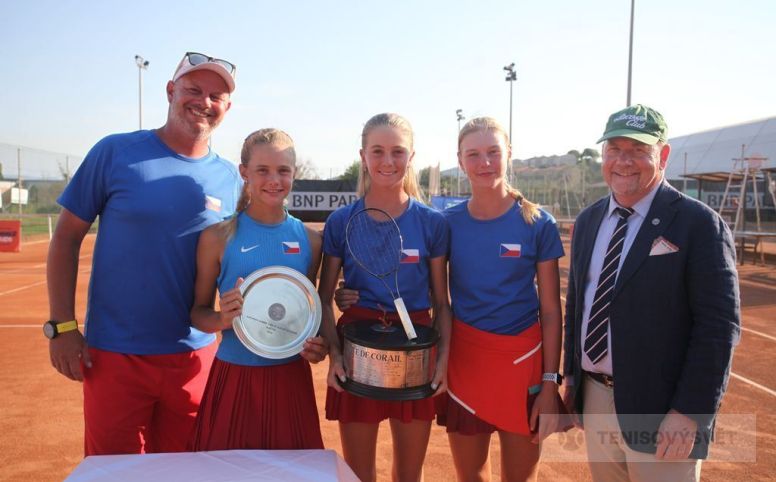
Every summer, the Tennis Europe Summer Cup Finals bring together the best U12-U18 players from across the continent. Federations with enormous budgets and federations with almost nothing all show up on the same clay. One nation keeps outperforming everyone else in the field: Czechia.
Population 10.9 million. Federation budget €8M - 1.7% of France's. In the 2026 Summer Cup Finals, Czechia reached more finals than France, Italy, Spain, Great Britain, or Germany. And it isn't one good summer: Czech girls have won the ITF World Junior title in five of the last six editions. We pulled apart the numbers - and the system behind them - to understand how a country this size builds this much depth on this little money.
Budget doesn't buy finals
Plot every federation in this year's field by annual budget against finals reached, and the pattern breaks immediately. Czechia runs on €8M a year and reached 7 of 8 finals. France runs on €460M - 57 times more - and reached 6.
Money isn't the bottleneck in junior tennis development. Czechia inherited its tennis system as civic infrastructure. Its biggest rivals built theirs as an industry - and every industry layer takes a margin.
The system: small country, ruthless proving ground
Weekly wars, 2-4 hours apart. 10.9 million people in a country you can cross in an afternoon means extreme player density. Top juniors drive 2-4 hours and face the best of every other region every single weekend. Elsewhere, a top junior meets her true rivals a few times a year. Czech kids calibrate weekly. Nobody gets comfortable.
1,100+ clubs, not 10 academies. A club in nearly every small town - 1,100+ for 18,500 registered players - acts as a massive top-of-funnel. Development happens in affordable local sports clubs, not multi-thousand-euro private academies. The entry barrier stays wide, so nobody with talent gets priced out before they're seen.
A fraction of Western Europe's cost. Recreational to full elite training in Czechia runs $2,150 to $52,000 a year, depending on level. Coaching and court time run noticeably cheaper than in Western European hubs like Spain or France.
Why an entire country's tennis runs cheaper
Bare club membership - court access, being on a team - runs €45-135 a year. Coaching is billed on top once a family pursues it. Four reasons the whole structure stays this cheap:
Most of the 1,100+ clubs date back generations - many to the Sokol movement, when courts were built as public civic infrastructure and land was granted, not bought. A Western academy fee amortizes real estate. A Czech club fee never has to.
Club fee schedules openly list brigádnické hodiny - mandatory volunteer work-hours. Members roll the clay and fix the fences, paying roughly €2-4 for every hour they skip. What's a payroll line in a US or Western European club is a membership duty in a Czech one.
Recreational clubs are nonprofit member associations (z.s.) - no owner, no investor return, fees set at cost recovery by an elected committee. Even where elite training turns for-profit - academies like Plíšková Tennis charge real fees - they're still built on cheaper Czech land and coaching labor than a comparable Western academy.
The national "Můj klub" program distributes roughly €61M a year across roughly 7,000 clubs, by registered athlete, across every sport in the country - not tennis specifically. Tennis clubs draw on it too: one more layer of public money sitting under the fee families actually pay.
The culture: what money can't buy
A 50-year chain of women, unbroken - and still winning Wimbledon. For Czech girls, tennis is the number one sport, while hockey drains the boys' talent pool. Every generation recruits the next.
Navrátilová → Mandlíková → Novotná → Kvitová → Plíšková → Krejčíková → Valentová
Four of these seven have lifted the Wimbledon trophy - Navrátilová nine times, Novotná once, Kvitová twice, Krejčíková in 2024. The chain is still producing: Valentová won junior Roland Garros in 2025.Parents are the primary engine. Because institutional funding is non-existent early on, parents drive the first grueling years - financially, logistically, emotionally. Czech federation officials say it openly: families sacrifice at a level that functions as a second, invisible budget line. The cost structure above only works because this one does.
Weekly battles against equals. No funding safety net until you've proven yourself. Parents all-in from year one. None of that is measured anywhere - but it's hard not to wonder whether this is where the mental toughness Czech players are known for on tour actually comes from. We can't prove the link. We can only show you the inputs.
What this means for programs everywhere
Czechia's system wasn't designed - it accumulated, over a century of civic sports infrastructure nobody else has. But the underlying logic travels: dense, low-cost access points beat a handful of expensive ones; weekly high-level competition beats occasional high-stakes competition; and a family's engagement in the early years matters more than a federation's early spending.
Squad Intelligence - Access density beats access quality at the entry level. More low-cost touchpoints surface more talent than fewer expensive ones.
Squad Intelligence - Weekly competitive density is a development lever on its own - a player who faces real rivals every week calibrates faster than one who faces them quarterly.
Player Retention - Fund proof, not promise. Czechia's federation backs players only once they've shown results - which keeps the system affordable enough to stay open to everyone until then.
Parent Communication - Parental investment in the early years isn't a side effect of a good system - in Czechia's case, it's load-bearing. Programs that make parents partners, not spectators, are building the same foundation.
Squad Intelligence - A visible, unbroken lineage of role models compounds. Every graduate who succeeds recruits the next generation for free.
Sources
National federation annual reports and public financial statements · 2026 Tennis Europe Summer Cup Finals results · ITF World Junior Tennis Finals results · Czech Tennis Association statements (Radio Prague International) · published Czech club fee schedules and statutes · Národní sportovní agentura "Můj klub" program figures · Czech regional press (Aktuálně.cz, Deník) · Prague-based academy pricing (stakhovskytennis.com, Plíšková Tennis Academy).